
Different layers
The philosophy of Bedaux Serious Games has been built up over time from different layers that complement, deepen and reinforce each other.
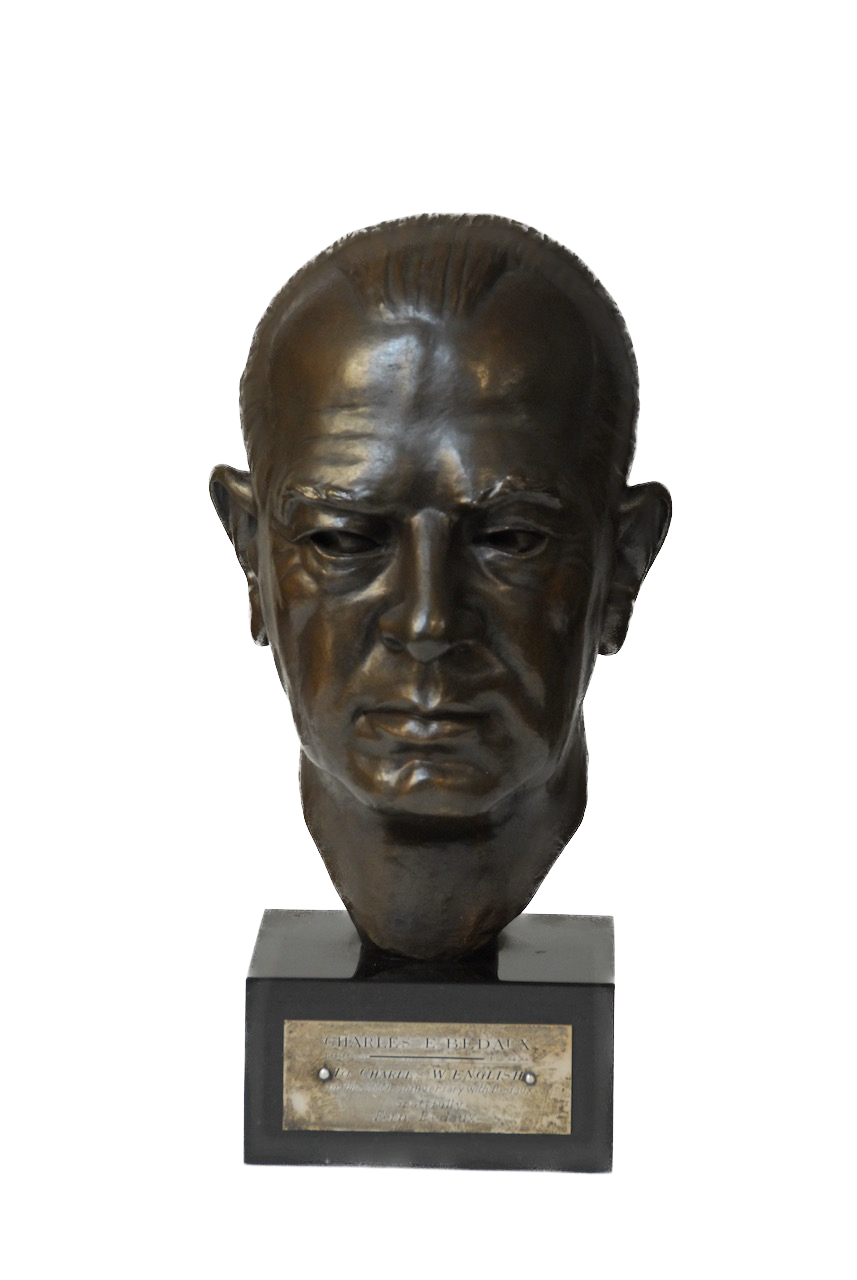
Charles
Eugène Bedaux
In 1916, Charles Eugène Bedaux (1886–1944) introduced the Bedaux System: the systematic study and analysis of human labour as a process. Work was broken down into steps, assessed and measured according to function and difficulty, and embedded in a management and remuneration system aimed at optimisation. This field was known as work analysis; today it is also referred to as industrial engineering or work simplification.
By the way: this unique bronze bust of Charles Bedaux, created in 1935 by Annie Höfken-Hempel, is on display in our own ‘Bedaux Museum’.

William Edwards
Deming
William Edwards Deming (1900–1993) saw organisations as systems of interdependent processes.
Important principle:
Most errors and variation arise in the system, not from individuals. Sustainable quality and better performance are achieved by systematically improving systems and processes, not by judging or punishing people.
Deming developed sampling techniques and management principles such as Statistical Process Control and the Plan-Do-Check-Act cycle. He had a major influence on post-war Japan and continues to form the basis for Six Sigma and Lean Six Sigma to this day.

Taiichi Ohno
Taiichi Ohno (1912 – 1990) is the primary designer of the Toyota Production System (TPS): a framework aimed at eliminating waste (‘muda’), reducing costs and improving quality. TPS laid the foundation for lean and introduced concepts such as Kanban and Kaizen, with an emphasis on systems thinking, problem solving and respect for people. Ohno thought in terms of flow, pull and variation control, making abstract ideas operational and observable. Together with Shigeo Shingo and Eiji Toyoda, Ohno made TPS a global standard for designing work in complex organisations, accommodating variations and learning without fear.

Masaaki Imai
Masaaki Imai (1930–2023) introduced Kaizen in his book ‘Kaizen: The Key to Japan's Competitive Success’ (1986), in which he explained the success of Japanese companies through their culture of continuous, small improvements.
Kaizen focuses on step-by-step improvement, involving employees at all levels of the organisation. The idea is that even small improvements yield enormous benefits in the long term.
An important concept in Kaizen is Gemba, which refers to the workplace where processes actually take place.

Johan Huizinga
Johan Huizinga (1872 – 1945) laid the cultural and philosophical foundation on which serious games were later built with his book Homo Ludens (1938). Learning, organising, collaborating and giving meaning are naturally playful activities. Play is not a fun way to make learning acceptable, but a primal form of human behaviour. This touches on the core of good serious games: they do not work primarily through instruction or coercion, but through engagement. Learning occurs because participants want to participate, not because they have to.

Bedaux
Serious Games
Bedaux Serious Games stands for an innovative concept in which play, work and learning are inextricably linked. Inspired by Johan Huizinga and reinforced by the thinking of Bedaux, Deming, Ohno and Imai, we design physical serious games in which people can experience complex issues within a safe, playful and meaningful context. Within these rules, participants discover for themselves how processes work, where cooperation stalls or accelerates, and which choices matter. We don't let organisations talk about improvement – we let them experience it.